
Flexible Spaces: How to Choose the Right Mobile Table
Sustainability Min.

The demands on modern workplaces are evolving. Spaces are increasingly designed to serve multiple purposes: what functions as a meeting room in the morning may become a hub for creative collaboration in the afternoon and a training space the following day. As a result, furniture is becoming an increasingly important element of future-ready workplace design. Flexible tables, such as Wilkhahn’s Timetable range, play a key role in this transformation.
Not every mobile or folding table is inherently suited to flexible use of space. It is only in day-to-day use that the ability of a table system to support different scenarios becomes apparent. Five criteria are particularly important when choosing the right solution:
Wilkhahn’s Timetable range comprises four flexible tables on castors, all based on the same principle: the tabletop can be flipped up in a few simple steps, allowing the table to be moved and nested for space-saving storage. Each model adapts this principle to meet different requirements. All four feature a protective edging that runs around the entire tabletop to prevent damage in everyday use and are designed for single-person operation. Lockable castors ensure that the tables remain securely in place once repositioned.
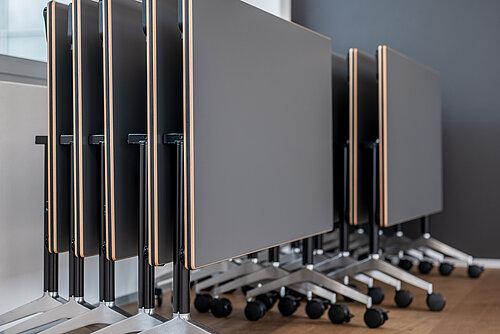
Timetable– the original. Timetable is the model that inspired the entire range: a folding conference table on castors with a patented mechanism that allows the tabletop to be flipped up in a few simple steps. As the tabletop tilts upwards, the feet automatically swivel inwards, transforming the work table into a compact piece of furniture that can easily be manoeuvred through doorways, into lifts and along narrow corridors. When nested, the first table takes up around 42 cm in depth, with each additional table adding just 8 cm – without any lateral offset. Sizes range from 60 × 140 cm for classroom-style layouts to 80 × 180 cm.
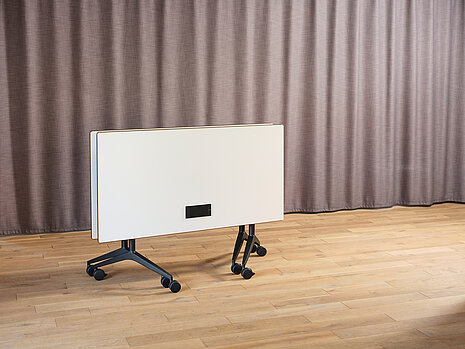
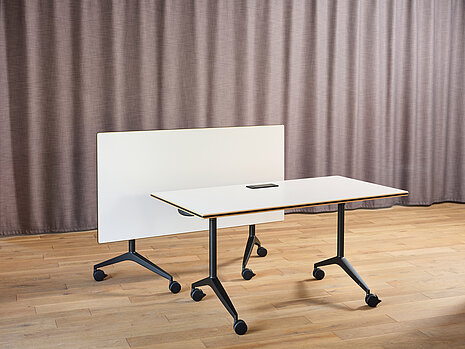
Timetable Smart– integrated power connectivity. Timetable Smart combines a robust design with integrated power connectivity. A horizontal release bar allows the tabletop to be unlocked, flipped up and securely locked in either the horizontal or vertical position. The feet do not swivel inwards, and the frame provides ample legroom along both long sides. Thanks to plug-and-play connectivity, multiple tables can be quickly linked to create connected workspaces with a continuous power supply – ideal for shared desks, training rooms or staff restaurants.
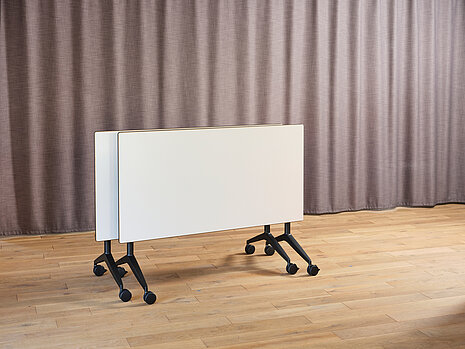
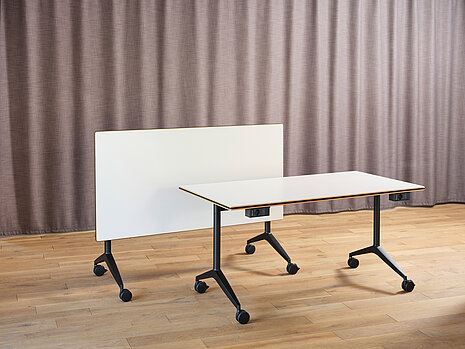
Timetable Shift – large formats for conferences. Timetable Shift demonstrates that generous tabletop surfaces and flexibility go hand in hand. Sizes range from 80 × 150 cm to 105 × 210 cm, complemented by two individual barrel-shaped formats. Using the release bar, a single person can easily flip up and securely lock even the largest tabletops. The tables can be linked to create continuous conference and seminar layouts, while an aluminium profile provides a spacious cable channel. Timetable Shift is designed to complement and integrate seamlessly with the Confair folding tables and Logon table systems.
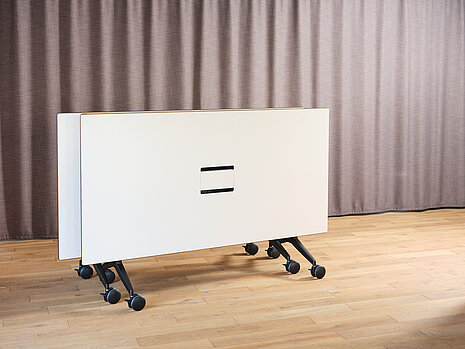
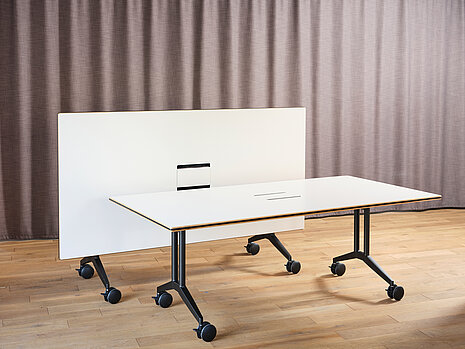
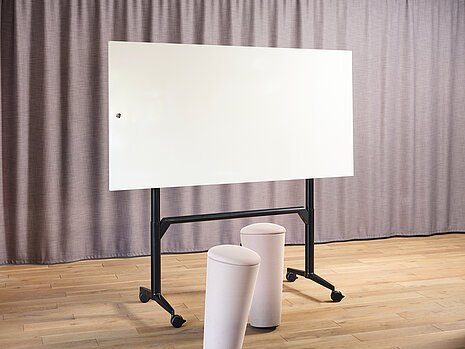
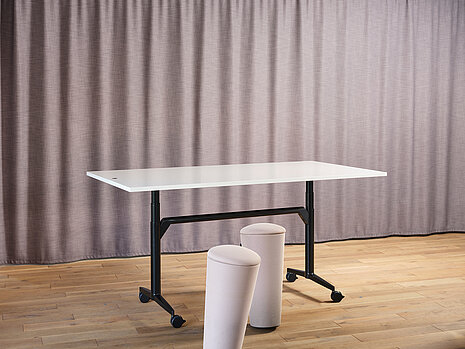
Timetable Lift – the height-adjustable folding table for workshops. Timetable Lift adds electric, stepless height adjustment to the range, from 73 to 139 cm, allowing users to switch from sitting to standing at the touch of a button. An optional rechargeable battery enables cordless operation. The writable tabletop, also available with a magnetic surface, doubles as a whiteboard or projection screen when needed. Optional features include a lectern function, holders for workshop materials and integrated power connectivity – ideal for workshop formats that involve switching between sitting, standing and presenting, as well as for hybrid collaboration. Like the other models in the range, Timetable Lift features a flip-up tabletop and can be nested for space-saving storage. It is available in 75 × 150, 80 × 160, 90 × 180 and 100 × 200 cm, as well as in a V-shaped tabletop version (model 615/13) measuring 75/90 × 180 or 75/100 × 200 cm.
| Model | Key features | Sizes | Typical applications |
|---|---|---|---|
| Timetable | Compact nesting; feet automatically swivel inwards | 60 × 140 cm to 80 × 180 cm | Conference rooms, staff restaurants |
| Timetable Smart | Integrated plug-and-play power connectivity and ample legroom | 60 × 120 cm to 80 × 160 cm | Shared desks, training rooms |
| Timetable Shift | Large tabletop formats and linking options | 80 × 150 cm to 105 × 210 cm, plus two barrel-shaped formats | Conference and seminar rooms |
| Timetable Lift | Electric height adjustment and writable tabletop | 75 × 150 cm to 100 × 200 cm; V-shaped tabletop (model 615/13) in 75/90 × 180 and 75/100 × 200 cm | Seminar, project, innovation and presentation spaces |
When different rooms within a building feature different tables that all operate on the same principle, users don’t need to learn a new way of handling furniture in each space. The tabletop is flipped up, and the table can be moved on its castors, nested for storage or repositioned – whether it’s Timetable in a training room or Timetable Lift in a project space. This makes it easier for users to actively reconfigure a room to suit their needs rather than simply working with the existing furniture layout. The shared design language also creates visual consistency across all spaces.
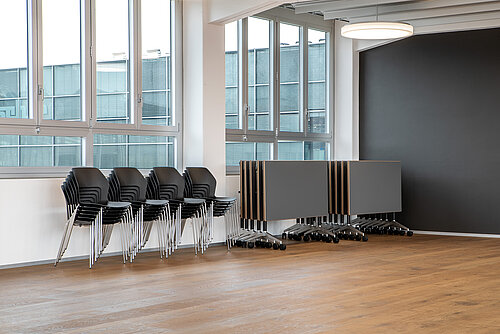
The true flexibility of a table is revealed not in a catalogue, but when a room needs to serve a different purpose. Well-designed flexible tables allow a single person to flip up the tabletop and move the table on its castors, take up minimal space when nested and offer the sizes and technical features required for the space.
Wilkhahn’s Timetable range achieves this through a shared design principle and four distinct models: Timetable for frequent reconfiguration, Timetable Smart for connected working, Timetable Shift for large tabletop formats and Timetable Lift for dynamic workshops.
Explore Wilkhahn’s full range of flexible table solutions in the “Folding conference tables and mobile tables” category.
Flexible table systems make it easy to adapt spaces to different uses with minimal effort. Depending on the model, the tables can be moved on castors, flipped up for compact storage or linked together to create larger table surfaces.
Flexible tables, such as mobile folding tables, are particularly well suited to conference rooms, seminar and training rooms, workshop spaces and multipurpose event venues. They allow furniture layouts to be quickly and easily adapted to changing spatial requirements and activities.
All Timetable models can be equipped with integrated power sockets, USB or data ports, and cable management solutions. These features are positioned to ensure they neither restrict legroom nor compromise the ease with which the tables can be reconfigured.
Choosing the right Timetable model depends on how the space is primarily used:
When nested with their tabletops flipped up, the first Timetable occupies around 42 cm in depth, with each additional table adding just 8 cm. Ten tables therefore require a storage depth of approximately 1.14 m, while twenty tables require around 1.94 m. In terms of space planning, this means that a storage area just two metres deep is sufficient to accommodate twenty tables, freeing up floor space for other activities.